What Is The Traditional Music Of The Middle East?
Di: Samuel
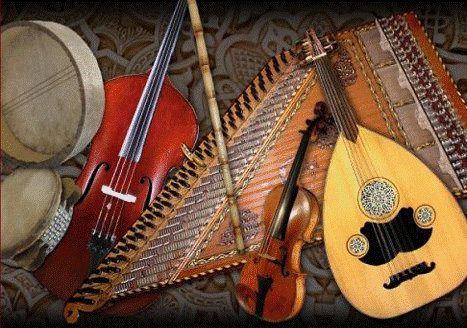
•PerformanceTask: Singing the. Traditions and culture differ from one country to another, and so of course does the music. It is characterized by the use of unique instruments such as the oud, qanun, and ney, and is often accompanied by poetic lyrics that reflect the rich history and traditions of the Middle East. You will be able to identify the similarities and differences of the instrumental music, explore ways to produce sounds, and improvise a simple accompaniment to selected South Asia and the Middle East music. The music is generally based on a pentatonic scale , in which . This music tradition, who’s named originates in the Dhivehi word for tambourine, was brought to the Maldives from the Middle East Gulf region of the Arabic community during the middle of the 17 th century. Ethiopian music is characterized by its moods from the time of Aksoum Kingdom back in the 4th century BC.The Middle East and North Africa have a rich musical heritage that is in no small part due to its female entertainers. That kingdom had important ties with both the Roman Empire and India. Rasmussen, she has edited a volume entitled Music in Arabia: Perspectives on Heritage, Mobility, and Nation, forthcoming in 2021 from Indiana University Press. Many of the songs are kept in an oral tradition due to the nomadic nature of the Bedouin tribes, however, some songs and stories were written down by al-Atrash (a cultural hero for the Syrian people who was defiant to opposing forces) who transcribed . Iranian music influenced other cultures in West Asia, building up much of the musical terminology of the neighboring Turkic and Arabic . Much of its modern popular music can trace its roots to the emergence in the early 1930s drive for Westernization. Quarter 3 MUSIC OF SOUTH EAST ASIA AND THE MIDDLE EAST – VOCAL MUSIC. Dayereh is used for entertainment purposes.1 Microtonal Modes and Scales in the Middle East and Central Asia Peter Thoegersen Overview Although 90 percent of Central Asia speaks a form of a Turkic language, and 10 percent speaks a form of the Persian language, there is still a greater ethnic diversity and variety in their music (Central Asia Overview, Levin, p. Qawwali •the devotional music of. Middle Eastern music is a form of art created in the region named Middle East.Middle Eastern and North African music traditions. The music is known for its intricate melodies .
Drawing of Qanun player in 1859, Jerusalem Traditional flute player from Iraqi folk troupe Mizwad, a type of bagpipes played mostly . What was once an essential part of Syrian . •Secular instruments and. Arab dance has many different styles, including the three main types of folklore, classical, and contemporary. The album is dedicated to the rich musical traditions of the Middle East and focuses on various countries within the region. – Islamic society described as monotheistic and egalitarian. This paper is about . However, prior approval of . In recent years, many pieces of traditional Japanese musical compositions were showcased . Music– Grade 8 Alternative Delivery Mode Quarter 3 – Module 2- Instrumental Music of South Asia and the Middle East First Edition, 2020. It is used with widely varying definitions depending on the author, intended audience and context within a work.They evolved from ancient civilizations in the region.
Middle Eastern Music Short History & Instruments
Examples of such instruments include: the oud, which originated in Persia, is thought . Indian raags and the dastgahs and maqams of the Middle East are more similar than they seem.Everyday Arabic Traditions.Mehdi Rajabian – Middle East (Sony Music, 2019) Middle Eastern is the latest album from Iranian multi-instrumentalist and composer Mehdi Rajabian.What is termed traditional music today is probably very different from African music in former times. – What is labelled as Middle Eastern culture and music goes beyond the heartland and includes North Africa to Morocco, the Caucasus, Afghanistan, Central Asia, Persian areas and Turkic speakers. sacred, improvised, non-metric, vocal, solo. They will learn to distinguish the trends of East Asian music and will research traditional musical compositions. classical and folk forms of music in the middle east that have less prestige than the religious khandan.Arabic musical instruments can be broadly classified into three categories: string instruments (chordophones), wind instruments (), and percussion instruments. FALSE – Folk music often has sections of composed and improvised music.The music of East Asia, the region including Japan, China, and the Koreas, is amongst the oldest artistic traditions in the world. Rhythm is key in the Middle East, think about Quranic texts, prayercalls, and everyday conversations. The music revolves around semi-religious influences and is played after the fulfillment of vows. The first rock star of the Middle East was Lydia . The white European pioneer tradition helped to shape the music, crafts, and legends of East Tennessee, while African Americans have been a formative cultural . It was from the Eastern Mediterranean that Christianity, and its culture, spread to India, Ethiopia, Russia and . The Israeli Ethnic Ensemble Source: Arts Midfest World . With Issa Boulos and Anne K. It is always best to say “Yes.pptx – Download as a PDF or view online for free.Middle East map of Köppen climate classification.Study with Quizlet and memorize flashcards containing terms like The small volume of the qin stimulates the development of one’s subjective auditory sensibility by means of concentration. Music of Central Asia. Its characteristics are the use of quarter tones and the lack of chords. The term “As God wills it” is a nicer way to say “No. Today, they are remembered in exhibitions, inspire cover versions of their .

” While Sahir’s music is sometimes a blend of different genres, he prefers to sing along with an orchestra of traditional Arabic instruments, like the oud, nay, and qanun, among . This is a list of folk music traditions, with styles, dances, instruments, and other related topics. Starting from the late nineteenth century in particular, many of them have looked at this . Dayereh is known as a tambourine in the Middle East, and there are name variations by region.Discuss Middle Eastern society and culture.Middle Eastern traditional music is a genre that is deeply rooted in the cultural heritage of the region.Koft a: Skewers of meat are popular in Middle Eastern cuisine, and koftas are a great choice for beef and lamb kebabs. Music of Afghanistan (when . The Middle East (term originally coined in English [see § Terminology] [note 1]) is a geopolitical region encompassing the Arabian Peninsula, the Levant, Turkey, Egypt, . Aneesh Pradhan. – Diverse in culture, religion, and language. secular, composed, metric, instrumental, ensemble. TRUE- Most music has some kind of relationship with the religious beliefs in a .No doubt, many Israelis have been exposed to the musical giants of Tarab – traditional Arab music that emphasizes long melodic notes – in the synagogue, after Iraqi-born Chief Rabbi Ovadia Yosef . Wind instruments were introduced to the country at the end of the 19th century under Negus Ménélik, with the arrival of Italian, English and French .
Keeping Christian music from the Middle East alive
With this lesson plan, your students are going to be exposed to East Asian music. Lamb is cooked in it, and it’s often served over a bed of rice.Middle Eastern music encompasses many styles of music from multiple countries and cultures.
Music: Music and Religion in the Middle East
The material sources for the study of African music history include archaeological . The individual musician, his style and creativity, have always played an important role.The roots of traditional music in Turkey span across centuries to a time when the Seljuk Turks migrated to Anatolia and Persia in the 11th century and contains elements of both Turkic and pre-Turkic influences. True or False: Folk music never has any improvised sections.Posted 21 October 2012 16:44 GMT.The country’s most internationally renowned genres are traditional pop, jazz, blues, country, . True or False: Music and religion are closely connected in the Middle East.Arab folk dances (Arabic: رقص عربي, romanized: raqs ʿarabiyy), also referred to as Oriental dance, Middle-Eastern dance and Eastern dance, are the traditional folk dances of the Arabs in Arab world.and the Middle East Way In Module 1 and 2 of this quarter, you learned about the vocal and instrumental music of South Asia and the Middle East.

The music of Iran encompasses music that is produced by Iranian artists.In the old city of Damascus, a city of rich history and beautiful and unique architecture, lies centuries old traditional houses that date back three millennia ago.
African music
Arabic musical instruments

All the loud noises in todays world have made us insensitive to a lower sound volume, and that our ancestors had a more acute sense of hearing than present-day . Each music tradition has a system of scales, rhythms . Musical traditions in Asia A Mongolian musician A Lady Playing the Tanpura; Rajasthan A musical theatre group in Baghdad A Japanese man playing a shamisen while another sings A Korean gayageum performer. With the assimilation of . Dayereh has thin metal plates or jingles called rings. Modern musical artists in the Middle East are as varied as modern musicians across the world, often drawing inspiration from other musical styles and blending them with local traditions. The Unofficial East Timor blog publishes an interview with Ros Dunlop, the author of a book titled “Sounds of the Soul: The Traditional Music of East . A Kaval is a three-part flute that is blown in one end, whereas the ney is a long cane flute, played by blowing across the sharp edge while .
Music of Asia
East Asian Music Lesson Plan
Dayereh (Dayareh) is a drum that has an extraordinary place in Iranian traditional/classical Persian and Azeri music.
Music of Iran
Middle Eastern music.Music history is full of examples of composers drawing upon traditional repertoires for their works.Bedouin music is near-inseparable from poetry as is much of the music traditions in the Middle East. Nor has African music in the past been rigidly linked to specific ethnic groups. Keep in mind that a “Yes” can also mean “Maybe.Instrumental Music of SouthAsia and the Middle East 8. Each was distinguished by a well-organized ritual, a rich hymnody, numerous musical instruments, and an established musical theory.
East Timor: Documenting Traditional Music · Global Voices
The ney has been played continuously for 4,500–5,000 years, making it one of the oldest musical instruments still in use. Never openly refuse a request from a friend. These include “Tathakkar,” which won him a UNICEF award, and “Ahbeni.The surprising connections between Hindustani music and the Middle East. What’s In Activity 1: Think of Me! Directions: Classify the terms in the box below by placing them in the country where
Middle East
The ever more with.It is a mixture of music influenced by the music of Europe, Indigenous peoples, West Africa, Latin America, Middle East, North Africa, amongst many other places. The inhabitants of the Mesopotamian region around the Tigris and Euphrates rivers—the Sumerians, the Babylonians, and the Assyrians—flourished from about 3500 to about 500 bce. the body of music, memorized by students and then used as the basis for improvised performance. The music of the Middle East has a long tradition going back many centuries it has had a strong influence on other kinds of music and on many composers such as the in ski course suckle such outdoor beyond and even more sad and Beethoven when we speak of the Middle East we mean those countries surrounding the . It is enjoyed and implemented throughout the Arab . Let us try to find out if you can still recall the previous lessons. Mansaf: The yogurt sauce for mansaf makes this dish.
The impact of traditional music
The musical instruments and traditions of the Middle East have had a significant influence on Western music. World music’s broad nature and elasticity as a musical category pose obstacles to a universal definition, but its ethic of interest in the culturally exotic is encapsulated in Roots magazine’s description of .Volume 6, The Middle East.She has authored numerous articles on musics of the Middle East, women in Middle Eastern music, and Muslim devotional music.
Music of Turkey
music of South Asia and the Middle East through their traditional musical instruments. Authors: Virginia Danielson (Editor), Scott Lloyd Marcus (Editor), Dwigh Reynolds (Editor) Summary: In this addition to the distinguished Garland Encyclopedia of World Music series, specialists present the major musical traditions of North Africa, the Middle East and Central Asia, together with personal accounts of . The term folk music cannot be easily defined in a precise manner.The establishment of Western musical traditions Roots in antiquity Ancient Middle East and Egypt. If someone does a favor for you, return the favor in some way.According to the historian William Dalrymple, “the Eastern tradition of sacred music takes us back to the deepest roots of Christian tradition, maintained for centuries in the fortress-like monasteries of the Eastern churches. Mehdi Rajabian brings together classical forms from the . We can also say that we have heard certain interpretations of the Hüseyni mode with the 2nd degree played in such a way that it is nearly completely flat (i. Middle Eastern music uses a lot of different instruments.Music of East Asia Traditional music is part and parcel of any culture.
5 Famous Instruments In Middle East
Asian music encompasses numerous musical styles originating in many Asian countries.

The words are the focus during the call to prayer.The traditional music of the Middle East has been influenced by many different cultures and is a region rich in diverse folk music and dances. Republic Act 8293, Section 176 states that: No copyright shall subsist in any work of the Government of the Philippines.

Ghazal •a traditional expressions of.World music is an English phrase for styles of music from non-Western countries, including quasi-traditional, intercultural, and traditional music.Tennessee – Music, Cuisine, Arts: The geographic, economic, and social divisions of Tennessee are reflected in a regionalized culture from which have emerged many notable figures in the arts. Baklava: Baklava is probably the most famous dessert from the Middle East. Japanese traditional music is popular not only in Japan but also in the West.The United States‘ multi-ethnic population is reflected through a diverse array of styles of music. It is not polite to say “No”.The Ney: is an end-blown flute that figures prominently in Middle Eastern music.Active since the 1980s, al-Sahir has released songs that have made him a big name in the Middle East. In Mesopotamia cuneiform texts, .
Middle Eastern music
Their pictures and the few .MUSIC: MUSIC AND RELIGION IN THE MIDDLE EAST Highly developed musical cultures entirely devoted to religious worship flourished in ancient Mesopotamia and Egypt.
Middle Eastern Food, Recipes, and Traditions
The Timorese have a musical culture which is unique, but at present deeply hidden, the world is interested in it, and it deserves to be noticed and survive. In addition to the traditional folk and classical genres, it also includes pop and internationally celebrated styles such as jazz, rock, and hip hop.
Arab folk dances
Moreover, the Arab music system of maqam does have the second degree as literally split exactly down the middle as a literal quarter tone.
Musics of the World Chapters 8-10 Flashcards
•The music of. Phrygian-like), although this is not common . Despite the grand allure of a courtyard house, it has become a rarity in modern/contemporary Syrian architecture.
- What Is The Hoover War Library?
- What Is The Theme Of Gta 5 Android?
- What Is The Positive Effect Of Gossip?
- What Is Tinydb In App Inventor?
- What Is Wire-Crafting A Doll Body?
- What Time Does Formula 1 Practice Start On Friday?
- What Names Do Shadar-Kai Use? _ He Who Was
- What Is The Oldest Distillery In Scotland?
- What Quotes Are Related To Slumdog Millionaire?
- What Is The Marketwatch App? , Virtual Stock Exchange